
Vitamins, sleep and hand-washing are winter staples, but your stress levels and relationships matter too. Discover what the research really says about stress, happiness and your immune system, and five simple ways to support your health through the colder months.
As winter approaches, many of us start thinking about how to protect ourselves against colds, coughs and other seasonal infections. We might stock up on vitamins, eat more healthily and make an effort to get enough sleep. But there is another factor worth considering: how we manage stress and look after our emotional wellbeing.
Research increasingly shows that your immune system does not work in isolation. It communicates constantly with the brain, nervous system and hormones. Chronic stress can disrupt some of these processes, while positive emotions and supportive relationships may help us cope with everyday pressures and keep up healthier habits.
So can happiness genuinely help you fight off winter colds? The answer is more nuanced than you might expect.

1. Understanding your immune system
Your immune system is the body’s natural defence network, working around the clock to identify and respond to harmful microorganisms such as viruses and bacteria.
Innate immunity
Your rapid, general first response to anything the body sees as a potential threat.
Adaptive immunity
Slower, targeted responses that can remember previous infections and react faster next time.
For these defences to work well, the body needs a carefully regulated balance of immune cells, chemical signals and inflammation. Too little activity can leave you less protected, while excessive or prolonged inflammation can damage healthy tissue.
Immune health is shaped by age, nutrition, sleep, physical activity, existing health conditions and exposure to germs. Research suggests psychological stress plays a part too, and this is where the science becomes particularly interesting.
2. How chronic stress can affect immunity
Stress is a natural response to challenge. When we feel threatened or under pressure, the body releases hormones such as cortisol and adrenaline. In the short term this helps us react quickly. When stress goes on for weeks or months, though, repeated activation of these systems can interfere with normal immune regulation.
A 2025 review in Molecular Biology Reports brought together evidence on how chronic stress can affect immune-cell activity, inflammatory signalling and the body’s ability to regulate its response to threats.
Long-term stress can also affect immunity indirectly, by disrupting sleep, changing eating habits and sapping motivation to exercise. If you’ve noticed stress showing up in your digestion as well, read Stress and Gut Health.
None of this means everyone under stress has a weakened immune system. The effects vary with the person, how long and how intense the stress is, and other health factors. But managing persistent stress is a worthwhile part of looking after yourself.
3. Can stress make you more likely to catch a cold?
Some of the most compelling research here comes from psychologist Sheldon Cohen and colleagues, who gave healthy volunteers carefully controlled doses of cold viruses and then monitored who became ill.
1993: stress and susceptibility
In a study of 394 healthy adults, those reporting more psychological stress were more likely to develop a clinically confirmed cold after exposure.
1998: it's the long-running stress
Among 276 adults, ongoing difficulties lasting a month or more, mainly work problems or strained relationships with family and friends, were linked to a two to three times higher risk. Short-lived stress was not.
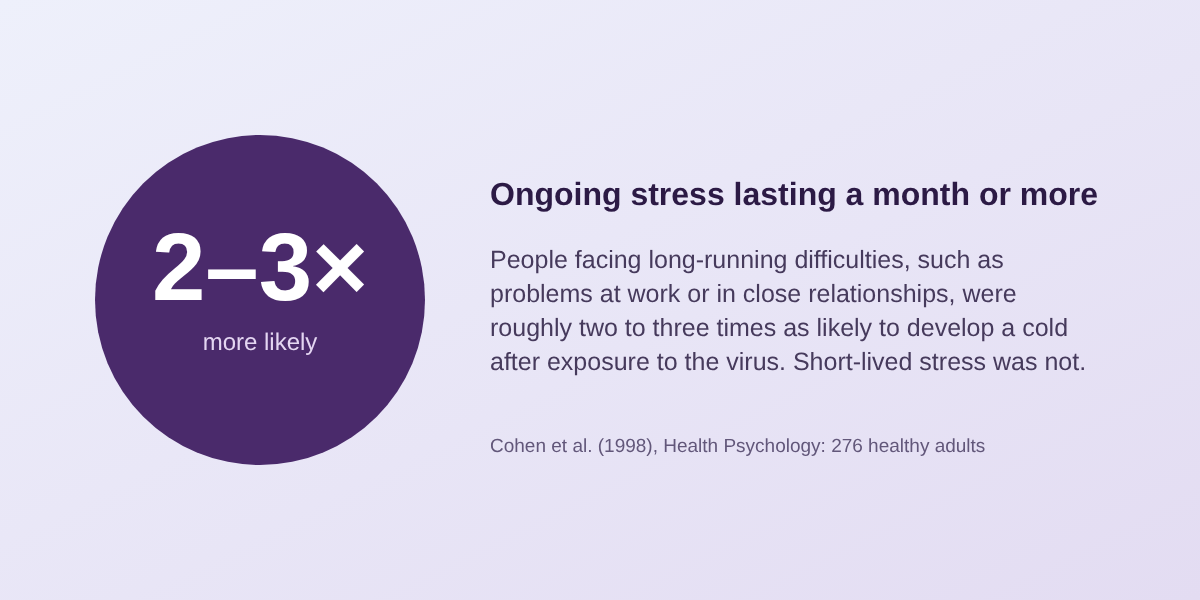
Stress doesn’t cause a cold: viruses do, and exposure, ventilation, sleep and existing health conditions all influence your risk. The evidence suggests that chronic stress may be one factor in how your body responds when it meets a virus.
4. Could happiness support your immune system?
Psychoneuroimmunology is the field that explores how emotions, hormones and the nervous system interact with immune responses. Experiences such as joy, gratitude, contentment and feeling connected may help us manage stress, rest and recover.
The same research group has looked at this too. In a 2006 study in Psychosomatic Medicine, people with a more positive emotional style were less likely to develop a cold after exposure to a virus, and reported milder symptoms when they did. In 2015, a study of 404 adults found that feeling supported, and even receiving regular hugs, appeared to buffer the extra infection risk linked to ongoing conflict with others.
These are associations, not proof that happiness protects you. Happiness shouldn’t be seen as an immune booster, but emotional wellbeing is a genuine part of the wider picture of health.
Feeling supported, managing stress and getting restorative sleep all work together. Emotional wellbeing is part of your immune health, not separate from it.
5. What happiness researchers say about connection
A paper published in October 2026 in the Journal of Happiness Studies, Reflections on the Past, Present, and Future of Well-Being Science from Several of Its Pioneers, brought together 13 leading wellbeing scientists to reflect on what decades of research have taught them, and how it shapes their own lives.
Rather than a new experiment, it’s a candid conversation between experts. Common themes included making time for close relationships (even having one person you can rely on), meaningful work, gratitude, savouring good moments and helping others. Wellbeing, they suggest, is less about feeling cheerful all the time and more about how we live, connect and adapt to change.
The paper doesn’t look at immunity directly, but it sits comfortably alongside the evidence linking chronic stress and social strain with changes in health. Looking after yourself this winter needn’t involve complicated routines or expensive supplements. Sometimes it starts with making time for the people and activities that make life feel connected.
Try this: a two-minute winter check-in
Once a week, sit somewhere quiet and ask yourself three questions:
- What has felt heavy this week, and has it been going on for more than a month?
- How have I slept, eaten and moved?
- Who have I really connected with, and who could I reach out to?
If stress is building, try one of the techniques in Reduce Stress in 60 Seconds.
Five ways to support your immunity this winter
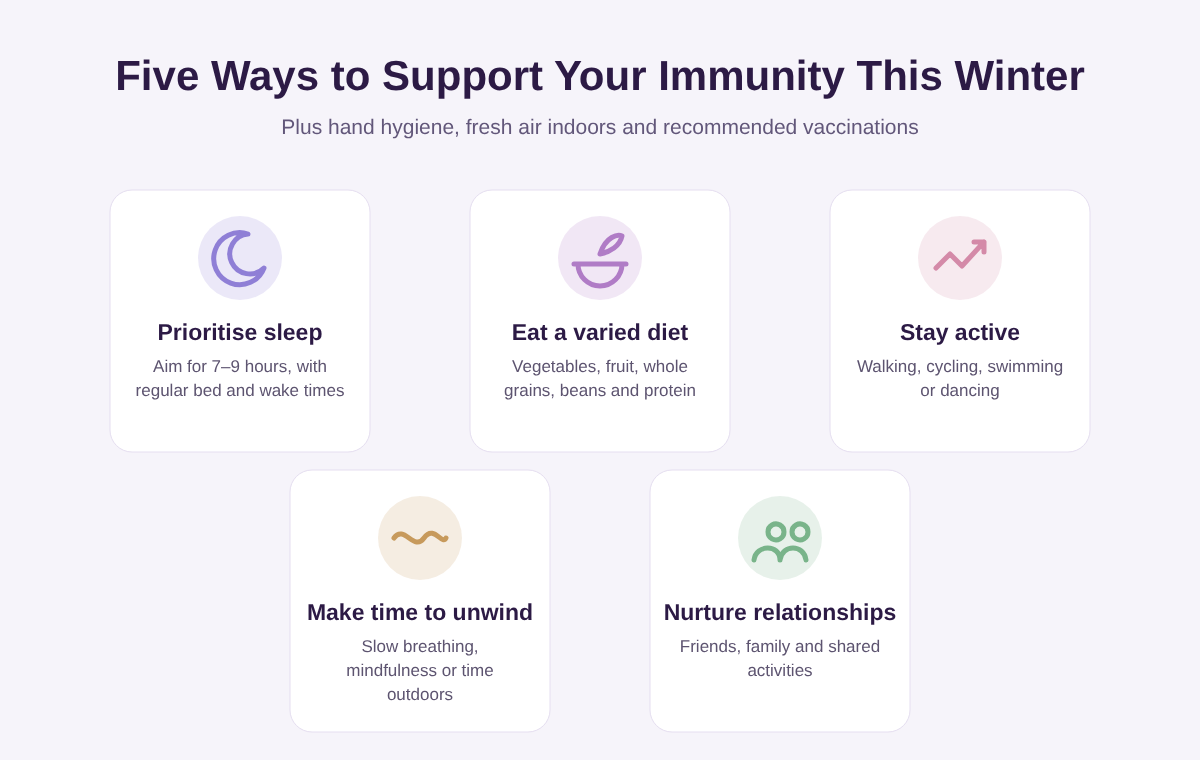
1. Prioritise sleep
Sleep supports normal immune regulation and recovery. Most adults need around 7 to 9 hours, with regular bed and wake times. The NHS has practical sleep tips.
2. Eat a varied diet
Include vegetables, fruit, wholegrains, beans, nuts and protein. Supplements can correct a deficiency, but extra vitamins don’t guarantee stronger immunity.
3. Stay active
Walking, cycling, swimming or dancing support mood and sleep. Choose something you enjoy so it lasts.
4. Make time to unwind
Try slow breathing, mindfulness, reading, gentle stretching or time outdoors. No single approach suits everyone, and if stress or low mood persists, seek professional support.
5. Nurture relationships
Make time for friends and family. Alongside this, keep washing your hands, let fresh air into shared spaces and have any recommended vaccinations.
A whole-body approach to winter immunity
Your immune system responds to much more than what you eat or which supplements you take. Sleep, stress, movement and your social world all play a part. Chronic stress can affect immune regulation and may make some respiratory infections more likely, while wellbeing research highlights the value of relationships, positive experiences and habits that help you cope.
It’s worth keeping the distinction clear: happiness can’t guarantee protection against a cold, and stress doesn’t mean you’re destined to become ill. But looking after your emotional wellbeing is valuable in its own right, and it complements the established ways of supporting your health.
This winter, give your body nourishing food, restorative sleep and regular movement, take practical steps to reduce exposure to infection, and make room for relaxation, laughter and connection. Supporting your immunity isn’t about one miracle solution; it’s about a combination of habits that helps you feel healthier, calmer and more connected through the colder months.
Is stress taking its toll this winter?
If ongoing stress, worry or difficult relationships are affecting your sleep, mood or health, talking it through can help. Lilly Wickham is an integrative psychotherapist working with the connection between mind, body and nervous system, including neurofeedback and personalised nutrition. Sessions take place at Hampshire Court Hotel, Basingstoke, and online.
Further reading: Explore the original research
Want to explore the evidence for yourself? These are useful starting points.
- Stress and colds: Cohen, S., Tyrrell, D. A. J. and Smith, A. P. (1993). Negative life events, perceived stress, negative affect, and susceptibility to the common cold. Journal of Personality and Social Psychology, 64(1). Read the abstract.
- Types of stress: Cohen, S. et al. (1998). Types of stressors that increase susceptibility to the common cold in healthy adults. Health Psychology, 17(3). Read the abstract.
- Positive emotions: Cohen, S. et al. (2006). Positive emotional style predicts resistance to illness after experimental exposure to rhinovirus or influenza A virus. Psychosomatic Medicine, 68(6). Read the abstract.
- Social support and hugs: Cohen, S. et al. (2015). Does hugging provide stress-buffering social support? Psychological Science, 26(2). Read the abstract.
- Stress and immune function: The multifaceted impact of stress on immune function (2025). Molecular Biology Reports. Read the review.
- Wellbeing science: Stenlund, S. et al. (2026). Reflections on the Past, Present, and Future of Well-Being Science from Several of Its Pioneers. Journal of Happiness Studies. Read the paper.
This article is for general information and is not a substitute for individual medical advice. If you have a long-term condition, a weakened immune system, or symptoms that are severe or not improving, speak to your GP or call NHS 111.