
Healing Emotional Trauma After Infidelity: Rebuilding Trust, Reconnecting With Yourself and Finding a Way Forward
Understanding the emotional impact of betrayal, how trauma affects the mind and body, and the evidence-based approaches that can help you heal after infidelity, whether you choose to stay or leave.
There are few experiences in a relationship as emotionally devastating as discovering that someone you love and trust has been unfaithful. Whether it involves a physical affair, an emotional attachment, repeated deception or a prolonged breach of trust, the impact can reach far beyond the relationship itself.
For many people, the discovery feels as though the ground has disappeared beneath them. The person they once considered their safe place may suddenly become the source of their deepest pain. Questions surface: Was anything real? Why did this happen? What did I miss? Can I ever trust again? And perhaps most painfully, what does this mean about me?
The emotional consequences can be profound: anxiety, intrusive thoughts, obsessive questioning, sleeplessness, hypervigilance, anger, shame, grief and a loss of confidence in your own judgement. For some, the experience is so overwhelming that it feels like an emotional trauma.
The encouraging news is that healing after infidelity is possible. With the right therapeutic support, an understanding of how trauma affects the nervous system, and a compassionate approach to emotional and physical wellbeing, you can move beyond the immediate pain and reconnect with a sense of safety, identity and self-worth.
Healing doesn't necessarily mean saving the relationship. It means recovering yourself, whether you ultimately choose to stay or leave.

Understanding the emotional impact of infidelity
Infidelity isn’t simply a relationship problem. It can be a significant rupture in your sense of emotional security, attachment and trust. We form intimate relationships partly for connection, belonging, stability and safety, so when that trust is broken the consequences can be far-reaching. You can read more about how relationships affect our health.
Psychologists use the term betrayal trauma to describe the psychological impact of being harmed by someone we depend on emotionally. Infidelity doesn’t automatically meet the clinical criteria for post-traumatic stress disorder (PTSD), but the emotional reactions can resemble some trauma responses.
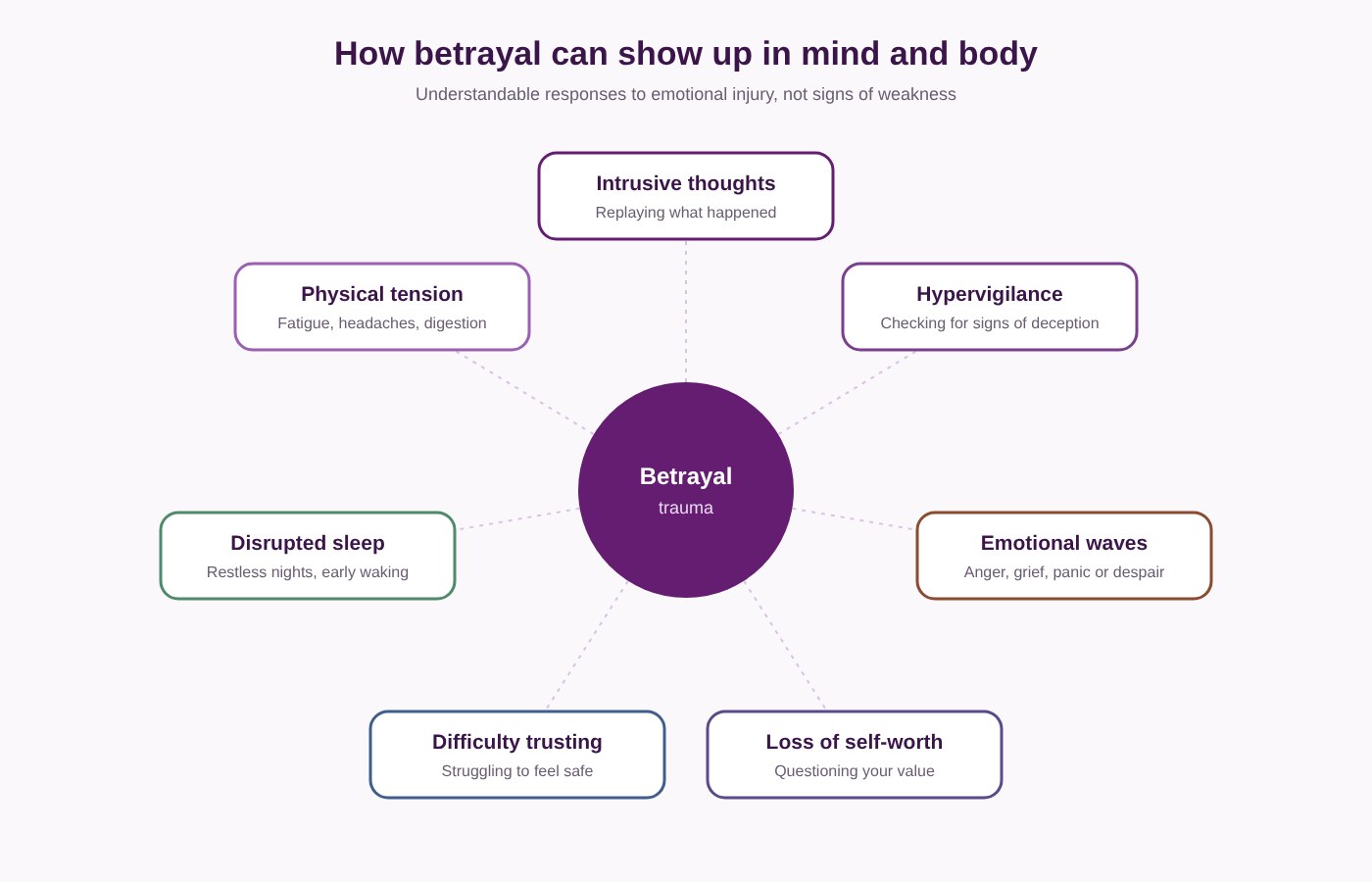
Intrusive thoughts
Repeatedly imagining what happened, replaying conversations or struggling to stop thinking about the betrayal.
Hypervigilance
Feeling constantly alert to signs of further deception, checking phones or social media, or becoming anxious when your partner is unavailable.
Emotional dysregulation
Sudden waves of anger, sadness, panic, fear or despair.
Loss of self-worth
Questioning your attractiveness, value, identity or adequacy.
Difficulty trusting
Feeling unable to relax emotionally, even in situations that once felt safe.
Sleep disturbance
Insomnia, restless sleep or waking with anxious thoughts.
Physical symptoms
Muscle tension, fatigue, headaches, digestive discomfort and changes in appetite.
One of the most confusing aspects of betrayal is how the mind becomes preoccupied with finding answers. You may feel compelled to revisit details, ask the same questions or search for information. This is often an attempt to restore a sense of control and make sense of something that has fundamentally challenged your understanding of reality.
Recognising these reactions as understandable responses to emotional injury, rather than signs of weakness, is an important first step towards recovery.
Why betrayal affects the nervous system
Our nervous system is continually assessing whether we’re safe or under threat. In close relationships, connection and attachment contribute to a sense of security, and betrayal can profoundly disrupt it.
The brain may begin to treat reminders of the relationship as threats. A delayed message, an unfamiliar name, a change in routine or a particular place can trigger an intense reaction, activating the sympathetic nervous system and releasing stress hormones such as cortisol and adrenaline. Some people feel constantly on alert; others feel numb, disconnected or exhausted.
This explains why you can understand intellectually that something is in the past and still feel it physically and emotionally. Healing therefore involves more than changing how we think. It also means helping the mind and body regain a sense of safety, which is where an integrated approach to emotional and physical wellbeing can be so valuable. If this sounds familiar, anxiety and emotional wellbeing explores it further.
Therapeutic approaches for healing emotional trauma
No single therapy works for everyone. The right approach depends on your experiences, symptoms, history, support and goals. However, several established approaches have strong research support for trauma-related difficulties. In the UK, NICE guidance recommends trauma-focused CBT and EMDR for PTSD, and the American Psychological Association’s 2025 guideline recommends cognitive processing therapy, prolonged exposure and trauma-focused CBT, with EMDR also suggested.
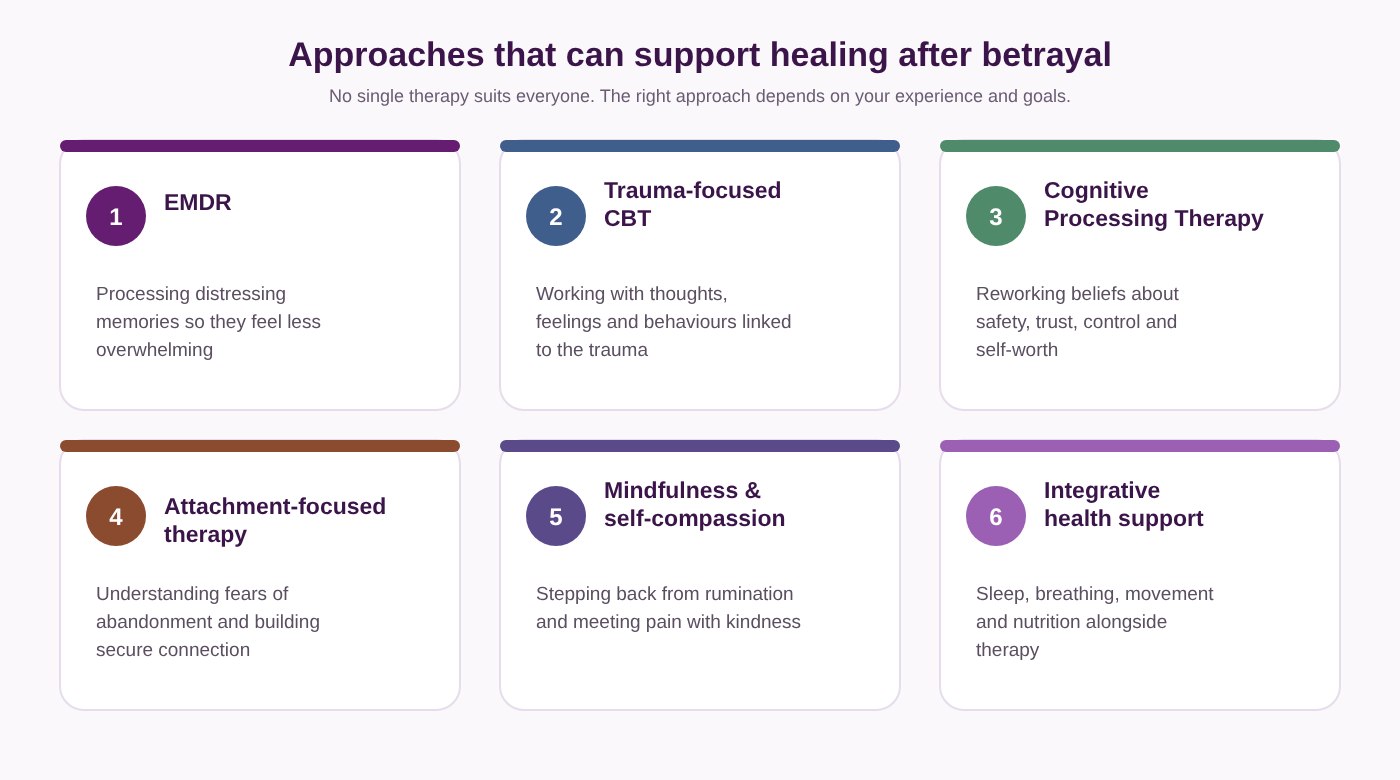
1. Eye Movement Desensitisation and Reprocessing (EMDR)
EMDR is an established trauma-focused psychotherapy that helps people process distressing memories and reduce their emotional intensity. A trained therapist guides you to focus on aspects of a memory while engaging in bilateral stimulation, usually guided eye movements or alternating taps.
EMDR should always be delivered by an appropriately trained practitioner who can assess its suitability and provide the preparation and stabilisation it requires. The EMDR Association UK holds a register of accredited practitioners.
After infidelity, targets might include
The moment of discovery · distressing images linked to the affair · conversations that still trigger distress · feelings of humiliation, rejection or abandonment · beliefs such as “I’m not good enough” or “I can’t trust anyone”.
2. Cognitive Behavioural Therapy (CBT)
CBT is one of the most extensively researched approaches for anxiety, depression and trauma. It explores the links between thoughts, emotions, physical sensations and behaviour, helping you identify unhelpful thinking patterns, weigh the evidence, develop more balanced perspectives and gradually change behaviours that keep anxiety going.
Trauma-focused CBT addresses traumatic experiences and their consequences directly. A 2025 individual participant data meta-analysis found trauma-focused CBT was considerably more effective than no treatment for reducing PTSD symptoms, and comparable to other active therapies. The aim isn’t to dismiss what happened or to ‘think positive’, but to build a healthier relationship with your thoughts, memories and emotions. Read more about cognitive and behavioural approaches.
Thoughts that can feel convincing
- “I’ll never be able to trust anyone again.”
- “It happened because I wasn’t enough.”
- “I should have known.”
- “I’ll always be hurt by this.”
- “Something terrible will happen if I stop checking.”
3. Cognitive Processing Therapy (CPT)
CPT is a specialised trauma-focused treatment that helps you identify and work through beliefs that have developed since a distressing experience, particularly around safety, trust, power, control, esteem and intimacy. After betrayal, you might come to believe that nobody can be trusted, that you’re fundamentally unlovable, that you’re powerless in relationships, that you can’t rely on your own judgement, or that you’re somehow responsible for what happened.
CPT helps you examine these beliefs, separate responsibility from self-blame, and develop more realistic and compassionate ways of understanding your experience. This can be especially valuable when infidelity has damaged your identity, confidence and sense of emotional security.
4. Attachment-focused therapy
Attachment theory helps explain why betrayal can be so destabilising. Early experiences of connection and care can shape how we experience intimacy, trust and separation as adults, and infidelity can activate deep fears of abandonment, rejection and not being worthy of love. You may find how childhood experiences shape adult health and generational trauma helpful reading.
Attachment-focused therapy explores these patterns in the context of your relational history. It can help you recognise your attachment needs, understand patterns of anxiety or withdrawal, develop healthier boundaries, build emotional independence, and establish relationships based on mutual respect and security. The aim isn’t to detach or avoid intimacy, but to be able to connect without losing your sense of self.
5. Mindfulness and self-compassion
Mindfulness helps you notice thoughts, feelings and bodily sensations without automatically reacting to them. After infidelity the mind can become caught in rumination, and mindfulness creates a little distance between a thought and the reaction it produces. Instead of being absorbed by “I’ll never trust again”, you can learn to recognise it as a fear-based thought arising from a painful experience. Why fighting anxiety can make it worse offers two practical exercises.
Self-compassion matters just as much. Many people turn their pain against themselves, questioning their appearance, intelligence, worth or ability to spot dishonesty. Self-compassion means treating yourself with the understanding you’d offer a close friend. It isn’t about excusing another person’s behaviour. It’s about no longer punishing yourself for something you didn’t choose.
Healing the body as well as the mind
Emotional trauma isn’t experienced only in the mind. It can affect sleep, digestion, appetite, energy, muscle tension and overall physical wellbeing, which is why recovery should consider both. Integrative health approaches can complement psychotherapy by supporting the foundations of emotional regulation and resilience. They shouldn’t replace evidence-based trauma treatment, but they can play a meaningful supporting role.
Breathing and relaxation
Find a comfortable position, let your abdomen expand gently as you breathe in, and exhale slowly for a few minutes without forcing or holding your breath. Progressive muscle relaxation, grounding through the senses or gentle movement can help if focusing on the breath feels uncomfortable. Try these 60-second techniques.
Nutrition
Prolonged stress can disrupt eating. Prioritise regular meals, plenty of vegetables and fruit, adequate protein, fibre-rich whole foods, omega-3 sources such as oily fish, walnuts and flaxseed, and good hydration. Research such as the SMILES trial suggests diet quality can contribute to mental health, though no food or supplement can erase emotional trauma. See the gut–brain connection.
Movement
Physical activity is linked with better mood, stress regulation and sleep, and can help you reconnect with your body and restore a sense of agency. Walking outdoors, swimming, yoga, Pilates, strength training, stretching or dancing all count. Consistency and enjoyment matter more than performance.
Sleep and recovery
Keep regular sleep and wake times, reduce caffeine later in the day, create a calm bedroom, avoid emotionally charged conversations just before bed, and build a soothing evening routine. If insomnia persists, CBT for insomnia (CBT-I) is the recommended first treatment.
Nature and the present moment
A walk in the park, time by the sea or simply sitting outdoors can shift attention away from rumination. The aim isn’t to avoid difficult emotions, but to create space for rest, perspective and reconnection with life beyond the betrayal.
Rebuilding self-worth after infidelity
One of the most damaging consequences of infidelity is its impact on self-esteem. People often internalise another person’s behaviour, comparing themselves with the affair partner, questioning their attractiveness or feeling they weren’t enough.
This is an understandable reaction, but another person’s decision to be unfaithful is not a measure of your value. You are not responsible for someone else’s dishonesty. Rebuilding self-worth means gradually separating your identity from what happened, so that this becomes one chapter of your life rather than your whole story.
Starting points
- Reconnect with interests that make you feel like yourself
- Spend time with people who offer genuine support
- Identify your values and personal strengths
- Set boundaries that protect your wellbeing
- Notice and challenge self-critical thinking
- Make decisions from your needs, not fear of abandonment
Can a relationship recover after infidelity?
For some couples, yes. But reconciliation is neither inevitable nor necessary for healing. Rebuilding a relationship takes far more than an apology or a promise. It involves restoring emotional safety and gradually establishing new foundations of trust. Couples therapy offers a structured space for both partners to explore the impact of the betrayal, understand the relationship’s dynamics and decide whether rebuilding is realistic and mutually wanted. Read more about systemic and relational work.
Accountability
The partner who was unfaithful takes responsibility without minimising, blaming or shifting it onto the betrayed partner.
Transparency
Honesty, and a willingness to address questions and concerns.
Emotional validation
The injured partner’s experience is acknowledged, not dismissed as jealousy or an inability to move on.
Consistency
Trust is rebuilt through reliable behaviour over time, not promises alone.
Boundaries
Clarity for both partners about what is acceptable and what emotional safety requires.
A 2025 systematic review of trust repair in couples by Giacobbi and Lalot brought together the research on how partners rebuild trust, and a 2026 thematic synthesis by Yalçın and Güler examined the processes of change across different couple therapy approaches after infidelity. Transparency, accountability, genuine remorse, open communication and shared positive experiences recur throughout this literature.
When couples therapy isn't appropriate
Where there is coercive control, intimidation, ongoing deception or abuse, individual support and safety planning come first. In the UK, the National Domestic Abuse Helpline (0808 2000 247) and the Men’s Advice Line (0808 801 0327) offer free, confidential support. If you’re in immediate danger, call 999.
And remember: forgiveness is a personal choice, not a requirement for recovery. You can heal without forgiving, and you can heal without staying.
Why healing is not a linear process
Progress rarely happens in a straight line. You may have several good days and then feel overwhelmed by a memory, a conversation or an unexpected reminder. You may feel confident one morning and deeply vulnerable that evening. This doesn’t mean you’re failing or going backwards. Recovery means gradually developing the ability to experience difficult feelings without being consumed by them.
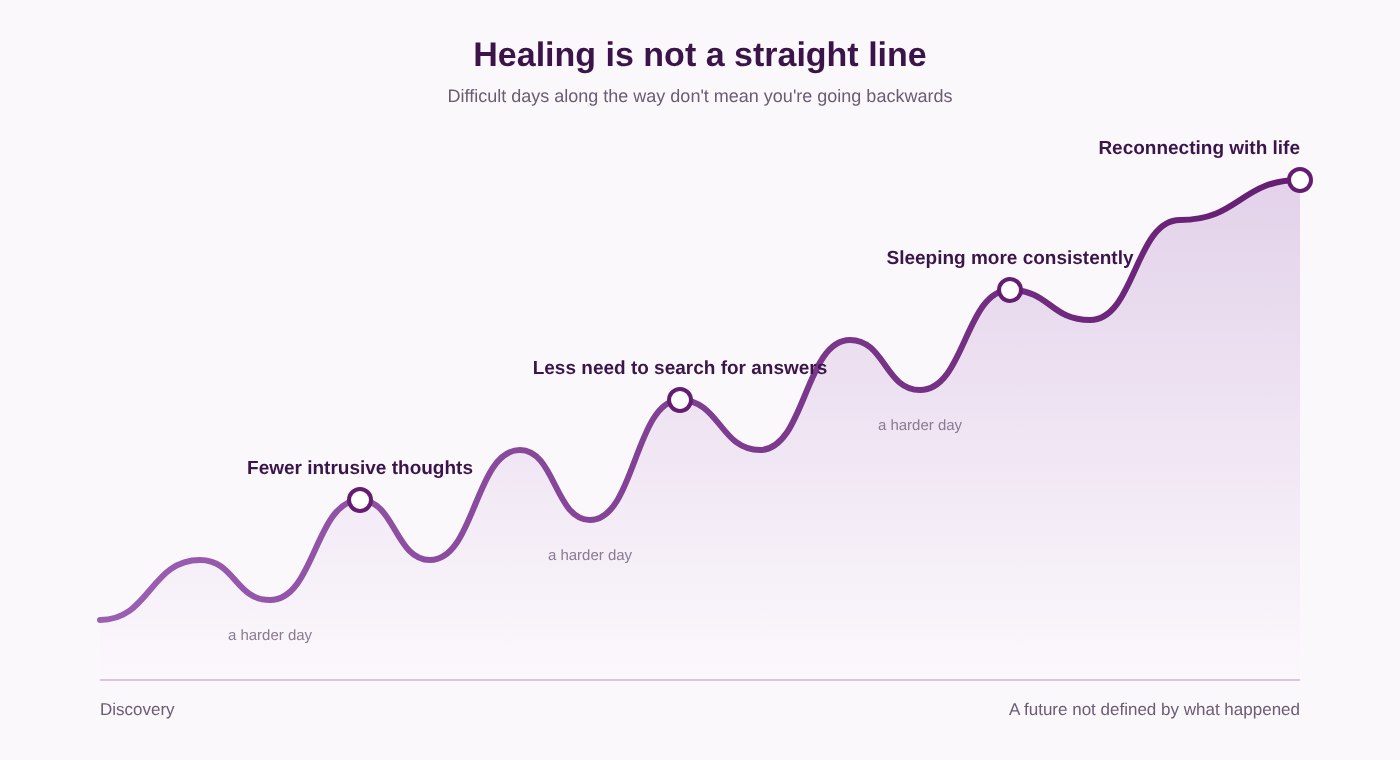
Over time, you may notice that intrusive thoughts become less frequent, you feel less compelled to search for answers, your reactions become less intense, you sleep more consistently, you feel more confident in your decisions, you reconnect with friendships and interests, and you begin imagining a future that isn’t defined by what happened.
Healing isn't about forgetting the betrayal. It's about reaching a point where the experience no longer controls your emotional life.
You don't have to navigate this alone
If you’re finding it hard to move forward after infidelity, or the impact of betrayal is affecting your confidence, relationships, sleep or ability to enjoy life, please don’t face it alone. Perhaps you feel stuck in a cycle of painful thoughts, struggling to make sense of what happened, questioning your self-worth or finding it hard to trust again. Whatever your experience, there is a way forward.
As a psychotherapist and integrative health practitioner, I take a holistic, individual approach to emotional healing, recognising that psychological, emotional and physical wellbeing are deeply connected. My work brings together an understanding of trauma, attachment and emotional patterns with established therapeutic techniques and supportive integrative health practices. Together, we can explore what has happened, understand how it’s affecting you, and work towards restoring your sense of safety, confidence and balance.
There’s no expectation that you should simply get over it, forgive, forget or make decisions before you’re ready. Whether you hope to rebuild your relationship, find the strength to move on, or simply feel like yourself again, the work is guided by your needs and goals. You deserve to feel emotionally safe, valued and at peace, and to have a life that isn’t defined by someone else’s choices.
Take the first step
Arrange an initial consultation to talk about what you’re experiencing, what you need and how I may be able to support you. Sessions take place at the Lilly Room, Hampshire Court Hotel, Basingstoke, and online.
References and further reading
- American Psychological Association (2025). Clinical Practice Guideline for the Treatment of PTSD in Adults. Read the guideline.
- NICE (2018). Post-traumatic stress disorder (NG116). Read the guidance.
- U.S. Department of Veterans Affairs and Department of Defense (2023). Clinical Practice Guideline for the Management of Posttraumatic Stress Disorder and Acute Stress Disorder. Read the guideline.
- Wright, S. L. et al. (2025). Efficacy of cognitive behavioral therapies with a trauma focus for posttraumatic stress disorder: an individual participant data meta-analysis. Journal of Consulting and Clinical Psychology, 93(6), 401–426. Read the study.
- Giacobbi, M. and Lalot, F. (2025). Unpacking trust repair in couples: a systematic literature review. Journal of Family Therapy, 47, e12483. Read the review.
- Yalçın, M. A. and Yavuz Güler, Ç. (2026). Post-infidelity interventions in couple therapy: a systematic thematic synthesis of change processes across therapeutic approaches. The American Journal of Family Therapy. Read the study.
- Jacka, F. N. et al. (2017). A randomised controlled trial of dietary improvement for adults with major depression (the ‘SMILES’ trial). BMC Medicine, 15, 23. Read the study.
- Freyd, J. J. What is a betrayal trauma? What is betrayal trauma theory? University of Oregon. Read more.
This article is for general information and does not replace individual assessment, diagnosis or treatment. If you’re struggling with your mental health, please speak to your GP. If you’re in crisis, call NHS 111 (option 2 for mental health), contact Samaritans on 116 123, or call 999 in an emergency.