
Histamine Intolerance, Stress and Gut Health: What to Know
Bloating, brain fog, fatigue, headaches or food sensitivities that no one can explain? Discover how stress, your gut microbiome and histamine intolerance may be connected, what the research really says, and how testing can help you ask better questions.
If you live with unexplained digestive discomfort, you’re certainly not alone. Gut-related symptoms affect millions of people and can have a real impact on energy, mood, sleep and quality of life. Irritable bowel syndrome (IBS) alone is thought to affect around 1 in 10 people worldwide, although estimates vary with the diagnostic criteria used.
Yet many people spend years trying to understand why their digestion feels out of balance.
Could stress, your gut microbiome or histamine intolerance be part of the picture? Let’s look at what we know, and what we’re still learning.
1. Your gut and brain are in constant conversation
Does your stomach play up when life gets stressful? Perhaps you feel bloated before an important event, notice changes in your bowel habits during a difficult week, or get digestive discomfort when you’re overwhelmed.
That’s the gut–brain connection in action. Your brain and digestive system communicate continuously through nerves, hormones and immune signals. Stress can change how quickly food moves through your gut, make the gut more sensitive to pain, and worsen bloating, discomfort, constipation and diarrhoea.
Poor sleep, rushed meals and long periods of stress can add to the problem. And it works both ways: ongoing digestive discomfort can affect your mood, sleep and wellbeing. (Read more in Stress, Sleep and Your Gut.)
So supporting gut health isn’t only about what’s on your plate. It’s also about how you rest, move, manage stress and give yourself time to recover. Mindful breathing, gentle exercise, regular sleep and eating without rushing may all help. They aren’t a cure for every gut condition, but they can be valuable parts of a wider approach.
Did you know?
The connection between mind and gut is recognised in UK guidance. For people with IBS whose symptoms haven’t improved with medication after 12 months, NICE guidelines recommend that psychological therapies, including cognitive behavioural therapy (CBT) and hypnotherapy, should be considered. Lilly is a qualified hypno-psychotherapist trained in CBT. Learn about hypno-psychotherapy.
2. Is it genetics, lifestyle, or both?
Usually it’s a combination. Genetics can influence our susceptibility to conditions such as coeliac disease and inflammatory bowel disease, and family history can contribute to the risk of IBS. Our immune system and environment shape how our bodies respond to different triggers.
But genetics isn’t the whole story. Diet, physical activity, sleep, stress, medication and other environmental factors all influence digestive health and the gut microbiome, the diverse community of microorganisms living in our digestive tract.
Not every gut condition is preventable or caused by lifestyle. Conditions such as Crohn’s disease, ulcerative colitis and diverticulitis need proper medical assessment and should never be dismissed as simply the result of lifestyle choices. But there are often meaningful steps we can take to understand our symptoms and support our wellbeing.
Knowledge creates awareness. Awareness creates opportunities for change. And small, consistent changes can make a difference.
3. Your gut microbiome: the missing piece?
Your gut microbiome helps break down food, produces substances that support normal body functions and interacts closely with your immune system. Researchers are increasingly investigating its role in digestive symptoms, inflammation and gut–brain communication.
An imbalance in the microbial community is often called dysbiosis. However, there is no single ‘ideal’ microbiome that applies to everyone, and a test result alone cannot show that an imbalance is causing your symptoms.
Understanding your microbiome can help inform conversations about dietary variety, fibre and lifestyle. The key is careful interpretation and looking at the whole person, rather than focusing on individual bacteria in isolation.
4. Histamine intolerance: could it be contributing to your symptoms?
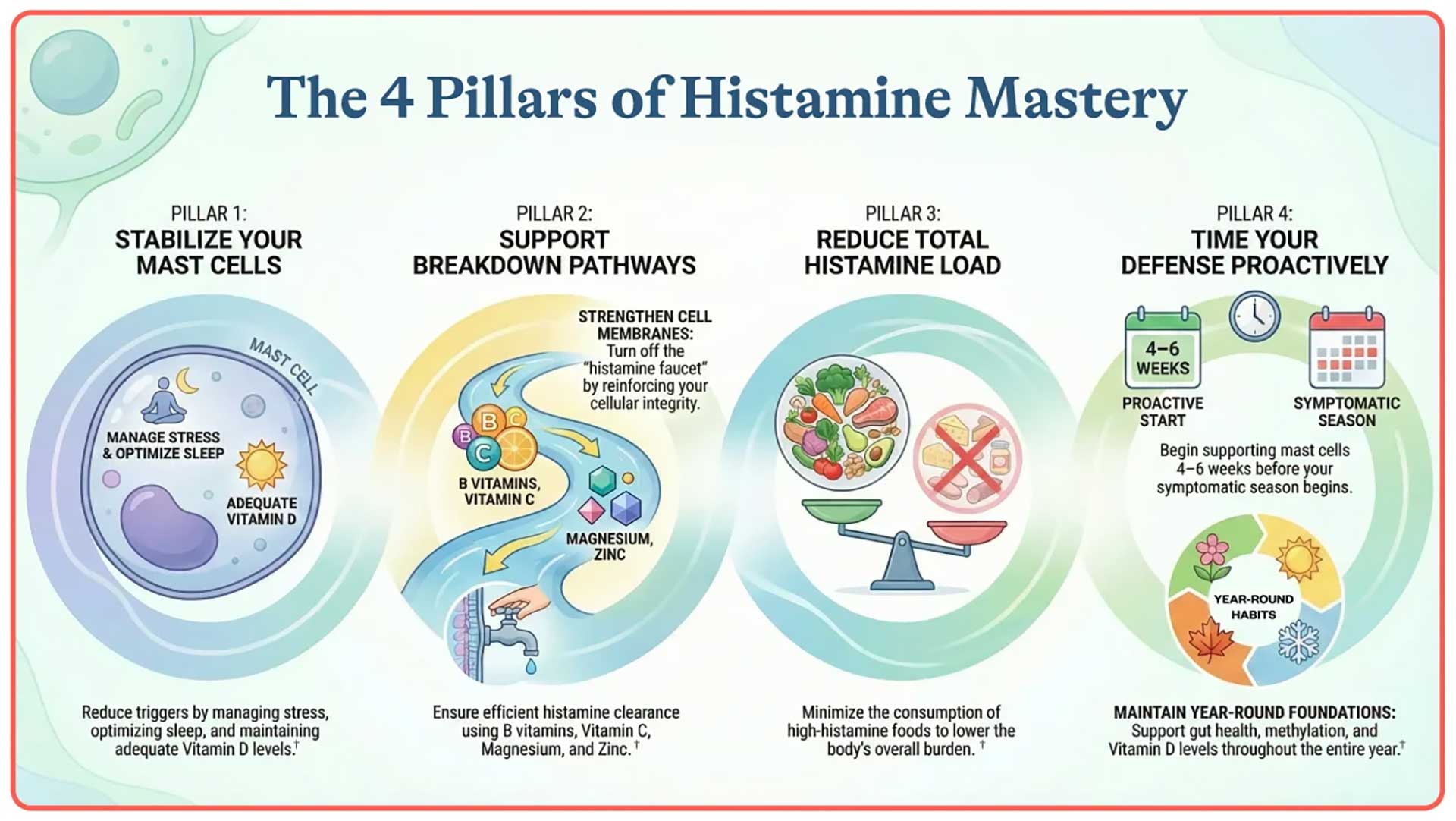
Histamine is a natural chemical involved in immune responses, stomach acid production and the nervous system. It is released by certain immune cells, found in some foods, and can also be produced by some gut bacteria.
Your body normally breaks histamine down using enzymes, mainly diamine oxidase (DAO) in the gut and histamine N-methyltransferase (HNMT) inside cells. Histamine intolerance describes symptoms that may occur when histamine builds up faster than the body can break it down. Reported symptoms include:
Digestive
Bloating, abdominal discomfort, nausea and diarrhoea
Skin
Flushing, itching, hives and rashes
Head
Headaches, including migraine in some people
Respiratory
Sneezing, runny nose or nasal congestion
Other
Dizziness, fatigue and palpitations
These symptoms are not specific to histamine intolerance and can have many other causes. Histamine intolerance is difficult to diagnose, and there is currently no single validated test that confirms it on its own.
5. What about IBS, inflammation and diverticulitis?
IBS: Research suggests that mast cells, immune cells found in the gut lining, and histamine signalling may contribute to abdominal pain and gut sensitivity in some people with IBS.
Inflammatory bowel disease: Scientists are investigating how histamine, gut bacteria and immune activity interact in Crohn’s disease and ulcerative colitis.
Diverticulitis is different. It happens when small pouches in the bowel wall become inflamed and sometimes infected, causing persistent abdominal pain, fever, nausea and changes in bowel habits. Although histamine plays a role in inflammation generally, there is no strong evidence that high histamine or histamine intolerance causes diverticulitis. This distinction matters, because diverticulitis may need medical treatment.
6. What is recent research telling us?
Histamine-producing gut bacteria
A 2022 study in Science Translational Medicine found that some people with IBS carried gut bacteria that produce high levels of histamine. In mice, these bacteria increased gut pain sensitivity through a specific histamine receptor.
Mast cells and IBS pain
A 2016 study in Gastroenterology showed how histamine can make gut nerves more sensitive in IBS, and found that an antihistamine reduced abdominal pain in a small trial.
Histamine intolerance
A 2020 review in Biomolecules described the wide range of reported symptoms and the difficulty of diagnosis, calling for more high-quality human studies.
The science is promising but still developing. An association between histamine and a condition doesn’t necessarily mean histamine causes it, and more research is needed to understand who may benefit from particular tests or treatments.
7. Exploring your gut and histamine with BIOVIS testing
If you’re curious about your gut health or wondering whether histamine could be relevant to your symptoms, several tests are available through the specialist laboratory BIOVIS:
Microbiome testing
A stool test exploring selected microorganisms in your gut. Findings can inform a discussion about digestive health, diet and lifestyle, but cannot diagnose most gut conditions on their own.
Histamine in stool
Measures histamine in a stool sample, relevant because some gut bacteria produce histamine. Levels fluctuate, and a raised result doesn’t prove histamine intolerance or DAO deficiency. Its clinical usefulness is still uncertain.
Methylhistamine in urine
Measures methylhistamine, a breakdown product of histamine, to help explore histamine metabolism. Protein intake and other factors can affect results, so careful interpretation is needed.
Histamine in urine
May be considered when investigating histamine-related symptoms. Levels fluctuate, and the result alone cannot diagnose histamine intolerance or a mast cell disorder.
Each test looks at a different aspect of gut health and histamine. Sometimes more than one may be considered, but combining tests doesn’t guarantee a complete explanation. Their value depends on the question being asked, each test’s limitations and how the findings are interpreted. Learn more about Lilly’s approach to integrative health and personalised nutrition.
8. Small changes, better understanding
While research continues, the foundations of good digestive health still matter:
Nourish your gut: eat a varied, balanced diet with plenty of fibre-rich plant foods, increasing fibre gradually as tolerated.
Manage stress: try mindful breathing, meditation, gentle movement or time outdoors. Reduce Stress in 60 Seconds is a good place to start.
Prioritise sleep: keep a regular routine and give your body time to recover.
Move regularly: find activities that fit your lifestyle.
Avoid unnecessary restrictions: if you suspect food-related symptoms, seek professional advice before cutting out multiple food groups.
Some people report improvements when they reduce certain high-histamine foods, such as aged cheese, cured meats, fermented foods and alcohol, but responses vary. A registered dietitian can help you explore dietary changes safely.
9. Try this: a two-week gut and histamine diary
A simple way to notice your own patterns before speaking to a professional
Each day for two weeks, jot down:
- Food and drink: what you ate and when
- Symptoms: what you noticed, how strong (1–10) and when it started
- Stress: your stress level that day, from 1 to 10
- Sleep: how long you slept and how rested you felt
- Cycle and medication: if relevant, as both can affect symptoms
Look back for patterns: do symptoms follow particular foods, stressful days or poor nights? A diary like this is far more useful to your GP, dietitian or practitioner than memory alone.
See your GP promptly if you have blood in your stool, unexplained weight loss, a persistent change in bowel habits, or severe or ongoing abdominal pain, especially with a fever.
A little more understanding can go a long way
Gut health is influenced by so many things: what we eat, how we sleep, our stress levels, our environment and our individual biology. Sometimes understanding more about what’s happening beneath the surface is a helpful first step towards changes that support your wellbeing.
There’s no pressure to test or change everything at once. Often the first step is simply asking questions, learning more and understanding what might be right for you.
Curious about histamine or your gut health?
If you’ve been living with ongoing digestive symptoms, wondering about histamine intolerance, or are simply curious about your gut microbiome, Lilly can talk through the testing options and whether any would be a useful part of your wider wellbeing plan.
Lilly Wickham is a clinical psychotherapist and integrative health practitioner in Basingstoke, seeing clients at Hampshire Court Hotel and online.
Further reading: Explore the original research
Want to explore the evidence for yourself? These are useful starting points.
- Histamine intolerance: Comas-Basté, O. et al. (2020). Histamine Intolerance: The Current State of the Art. Biomolecules, 10(8), 1181. Read the review.
- Histamine-producing gut bacteria: De Palma, G. et al. (2022). Histamine production by the gut microbiota induces visceral hyperalgesia through histamine 4 receptor signaling in mice. Science Translational Medicine. Read the study.
- Histamine and IBS pain: Wouters, M. M. et al. (2016). Histamine receptor H1-mediated sensitization of TRPV1 mediates visceral hypersensitivity and symptoms in patients with irritable bowel syndrome. Gastroenterology. Read the study.
- IBS guidance: NICE (CG61). Irritable bowel syndrome in adults: diagnosis and management. Read the guideline.
- NHS information: Irritable bowel syndrome and Diverticular disease and diverticulitis.
This article is for educational purposes and is not a substitute for medical advice, diagnosis or treatment. Commercial microbiome and histamine tests have limitations and should be interpreted appropriately. Persistent digestive symptoms should be discussed with your GP. Severe or persistent abdominal pain, particularly with fever, needs prompt medical assessment.