
AI Therapy vs a Human Therapist: Why Connection Heals
AI chatbots can now offer round-the-clock support and even sound remarkably caring. So can AI therapy replace a human therapist? Here’s what the research says about AI, empathy and the therapeutic relationship, where digital tools genuinely help, and why healing still happens between people.
We are living through a quiet revolution in mental health care. Algorithms can analyse the tone of someone’s voice for early signs of depression, take on the time-consuming work of clinical notes, and power chatbots that offer cognitive reframing at any hour of the day or night. To a technologist, the answer to the mental health crisis can look simple: scale up the algorithms, widen access, and code our way out of suffering.
Yet to anyone who has sat in the therapist’s chair, or wept in it, that view can feel profoundly hollow.
As AI therapy tools become part of everyday conversation, we face a foundational question: what actually heals us? Strip away the protocols and checklists, and what is the active ingredient in change? Decades of research, and the lived experience of countless clients, point the same way. Healing rarely happens through information alone. It happens through relationship, presence and the human connection between therapist and client.
1. What AI can already do
It’s worth being honest about the progress. Some findings are genuinely striking:
Responses rated as more empathic
In a 2023 study in JAMA Internal Medicine, healthcare professionals compared written answers to 195 patients’ questions. Without knowing who wrote them, they rated ChatGPT’s replies as empathic far more often than doctors’ replies.
Early trial results
In the first randomised trial of a generative AI therapy chatbot (Therabot, NEJM AI, 2025), 106 adults saw reductions in depression and anxiety symptoms over eight weeks compared with a waiting group. Its own authors stress it is not ready to work without clinician oversight.
So AI can produce words that sound caring, and carefully designed tools may help some people with some symptoms. But sounding empathic and being in a healing relationship are not the same thing.
2. What actually heals: the relationship
When researchers ask clients what made therapy work, people rarely point to a particular worksheet, a clever reframe or a well-timed homework task. They talk about feeling deeply seen. They describe a silence that felt safe enough to hold their grief, and a therapist whose steady, non-judgemental acceptance they could feel.
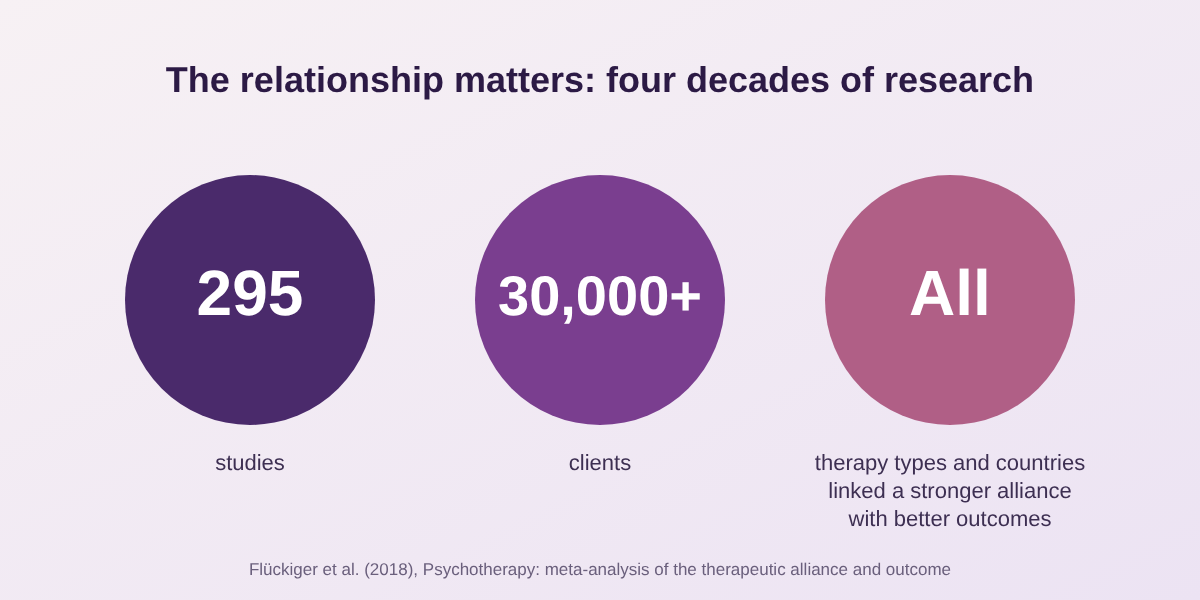
The numbers support this. A major 2018 meta-analysis brought together 295 studies involving more than 30,000 clients. Across therapy types, measures and countries, a stronger therapeutic alliance (the bond, trust and shared goals between client and therapist) was consistently linked with better outcomes.
Psychologists Shari Geller and Stephen Porges call part of this therapeutic presence: a therapist being fully grounded, open and attuned to the client in the moment. They suggest presence helps clients’ nervous systems register safety, through tone of voice, facial expression and posture. It’s the micro-expressions, the shared sighs and the intuitive pauses that happen between two nervous systems settling together.
An algorithm can produce the words “I understand how painful that must be for you” in milliseconds. But the machine does not understand. It has no heart to break, no history of sorrow of its own, and nothing to lose by being with you.
3. Empathy without a self
In 1957, psychologist Carl Rogers set out the conditions he believed were necessary for therapeutic change. Three of them have become the heart of the counselling relationship:
Empathy
Understanding a person’s inner world as if it were your own, and communicating that understanding.
Congruence
Being genuine, real and transparent in the relationship, rather than playing a role.
Unconditional positive regard
Warm acceptance of the person, without judgement or conditions.
AI can simulate empathy. It can never achieve congruence, because being authentic requires a self to be authentic to. And acceptance from a program costs it nothing, so it carries little emotional weight.
4. Relational wounds heal in relationship
Human beings are wired for attachment and social safety. Many people come to therapy carrying deep relational wounds: abandonment, betrayal, or not being believed by the people who were meant to care for them. Because those wounds happened in relationships, they are often best healed in one.
When a therapist sits with a client’s deepest shame and stays present, steady and warm, something shifts. The client begins to learn that they can be fully known and still fully accepted. That experience of a secure base is something a screen cannot offer.
A screen can reflect an image, but it can never hold space.
5. Why integrated therapy needs a human
In my practice, healing is never one-size-fits-all. Depending on what each person needs, our work may draw on several approaches:
Body and nervous system
Relationships and history
Systemic work, exploring family patterns and the relationships that shaped you.
A chatbot responds to the words you type. It cannot see your breath catch, your shoulders brace, or your voice soften when a difficult memory surfaces, and then move gently from a cognitive tool to something deeper. Integrated care relies on an embodied practitioner who can hold all of you at once: your thoughts, your body, your history and your relationships.
Therapy is also a creative, unfolding process. Some of the most important moments are unscripted: a slip of the tongue, shared laughter at something absurd, or a feeling the therapist notices in their own body and carefully uses to understand your inner world. These moments can’t be mapped in advance.
6. When a chatbot gets it wrong
Sharing something painful with a chatbot may feel safe in the moment, but tools built for general conversation aren’t designed to hold that responsibility. A 2025 Stanford study tested popular AI “therapist” chatbots and found worrying gaps. Several showed more stigma towards conditions such as alcohol dependence and schizophrenia than towards depression. When one test user hinted at suicidal thoughts and then asked about tall bridges, some bots simply listed the bridges. Newer, larger models were no safer than older ones.
The researchers concluded that AI should not replace human therapists, although it may support their work.
7. A scaffold, not the building
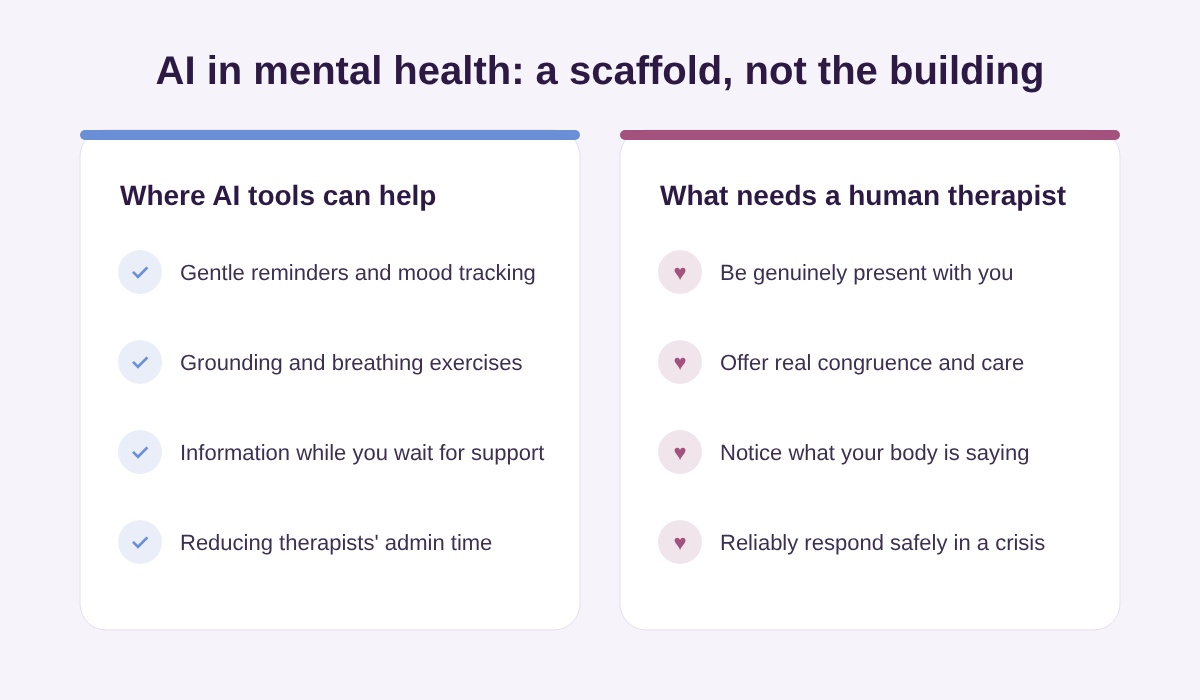
None of this means AI has no place in mental health. It has real potential as a supportive tool: it can reduce administrative work so clinicians spend more time with clients, and it can offer accessible information and coping strategies to people waiting for support.
It can act as scaffolding, but it must never be mistaken for the building itself. When we turn AI from an assistant into a stand-in for relationship, we confuse the transmission of information with genuine connection.
Try this: using a mental health app wisely
If you use a chatbot or wellbeing app, these questions can help you use it safely:
- What is it for? Grounding exercises, mood tracking and information are good uses. Working through trauma or a crisis is not.
- Who is behind it? Check whether clinicians were involved and how your data is stored and used.
- How do I feel afterwards? Calmer and more connected, or more isolated? Notice whether it’s replacing contact with people.
- Do I know where to turn in a crisis? Keep a human contact, and the numbers below, close to hand.
Protecting the human element
As our world becomes ever more digital, safeguarding the human element in psychotherapy is not resistance to technology; it’s an ethical necessity. Training, policy and clinical practice all need to honour the therapeutic space.
The power of psychotherapy lies in its vulnerability: one person bravely opening up to another, and the privilege of being trusted to witness it. However sophisticated technology becomes, there is no algorithm for presence and no digital substitute for the healing power of being understood by another human being.
Choosing your path: finding true connection
If you’re going through a difficult time, it’s completely natural to look for immediate support. Well-designed digital tools can be a helpful starting point, offering grounding exercises, mood tracking or ways to practise managing stress and anxiety in the middle of the night. Think of them as a compass when you feel lost.
But a compass can only show you a direction; it cannot walk the path with you. Lasting emotional healing needs a witness: a relationship built on trust, shared humanity and real-time empathy.
Ready for a human connection?
If you’re ready to move beyond automated answers, Lilly Wickham offers integrative psychotherapy tailored to you, bringing together mind, body and relationships. Sessions take place at Hampshire Court Hotel, Basingstoke, and online.
Need help now? If you’re in crisis or worried about your safety, call Samaritans free on 116 123 (24 hours a day), call NHS 111 and choose the mental health option, or call 999 in an emergency.
Further reading: Explore the original research
Want to explore the evidence for yourself? These are useful starting points.
- The therapeutic alliance: Flückiger, C., Del Re, A. C., Wampold, B. E. and Horvath, A. O. (2018). The alliance in adult psychotherapy: A meta-analytic synthesis. Psychotherapy, 55(4). Read the study.
- Therapeutic presence: Geller, S. M. and Porges, S. W. (2014). Therapeutic presence: Neurophysiological mechanisms mediating feeling safe in therapeutic relationships. Journal of Psychotherapy Integration, 24(3). Read the study.
- Core conditions: Rogers, C. R. (1957). The necessary and sufficient conditions of therapeutic personality change. Journal of Consulting Psychology, 21(2). Read the paper.
- AI and empathy: Ayers, J. W. et al. (2023). Comparing physician and artificial intelligence chatbot responses to patient questions posted to a public social media forum. JAMA Internal Medicine. Read the study.
- AI therapy trial: Heinz, M. V. et al. (2025). Randomized trial of a generative AI chatbot for mental health treatment. NEJM AI. Read the study.
- AI therapy risks: Moore, J. et al. (2025). Expressing stigma and inappropriate responses prevents LLMs from safely replacing mental health providers. ACM FAccT 2025. Read the study.
This article is for general information and reflects the author’s professional perspective. It is not a substitute for individual advice from a qualified professional.